Friday, February 14, 2014

Practical Teaching Tip: How to make Slip and other Slip Tidbits

Ceramics teachers have many methods to slipping and scoring 2 pieces of clay together. I have heard of teachers just using vinegar as a binder or teachers mixing their own slip. My preference is to mix my own slip. The important aspect of making slip is to make sure that you are using your clay body to create the slip.


Materials to make slip:

  • Bone Dry pieces of clay (make sure it is completely dry and smashed up)
  • Water container
  • Water
  • Vinegar
  • Food Processor or Blender
  • Squeeze bottler
  • Spoon


Step 1: Gather pieces of bone dry clay and smash it into smaller pieces. I used to keep a 5 gallon paint bucket in the front of the classroom for dried out pieces of clay, but then the students started putting pieces of clay that were not bone dry (just dry enough that they didn't want to use it). SO I now keep that bucket hidden from the students and do my own collecting.
Bone Dry Clay before it has been smashed


Step 2: Once you have a pieces of bone dry clay smashed up, put them in some type of container. Fill the container up with water so that it covers the clay completely. Let sit over night

Step 3: Dump out or scoop off the top layer of excess water.
This is how the clay should look, completely soaked and settled to the bottom. The excess water will be on top.


Step 4: Begin scooping the clay into the food processor or blender. I used to use a blender, but it died and the food process works much better at chopping up the clay to a nice consistency. I mix 75% water and 25% watered down clay mixture. At this point I also add a couple cap fulls of vinegar. I don't have a specific amount of vinegar that I use, a little goes a long way. The vinegar acts as a bonding agent/glue for the slip. You do not have to add the vinegar, but I find that it holds the slip together better.

Step 5: Run the blender or food processor until the slip is the consistency of runny yogurt. You may need to add more water along the way.

Storage of the Slip: The slip with vinegar is only good for a couple weeks. After that it can start to grow mold and smell (more than it does already). I don't make a lot at a time for this reason. Take out containers are great to store the slip (i.e. clear wonton soup containers).

Additional Tip: I used to pour out the slip for each table in my classroom to share and cover the containers at the end of the night with saran wrap. The issue I faced with this is the slip drying out after a few days. My new trick is one that I found on Pinterest where you put the slip into squeeze bottle containers- this works great!!!! (I had some left over from tie dying) The squeeze bottles are less messy and all the students have to do is squeeze the slip out to the area that they need to attach. Just make sure if you use squeeze bottles that the opening is cut enough so that the slip can come out easy and make sure that the slip is a little more watered down than yogurt. One other (funny) issue is that if there are air bubble built up in the clay or if there is a chunk of clay that tries to come out, when the student squeezes the bottle the slip kind of flies out and my kids say that it "poops" out- high schoolers for ya!


Hope these tips were helpful!
How do you make your slip? 
Do you even use slip or just vinegar? I love to learn about new ideas in your room!

Thursday, February 6, 2014

Practical Teaching Tip: The "I'm Done" Binder

In my classroom my students are usually working on a couple assignments at a time. Finishing up one and starting to glaze another one. There are times though, after they have finished their artwork and sketchbook assignment, that there is some down time. If I just tell the students to do homework from another class or read a book, it usually doesn't happen and extra talking and disruption emerges. By nature I am a busy body, so I don't like there to be any down time. When this instance does occur I have created a solution the "I'm done" Binder.

What is the "I'm Done" Binder?
I'm so glad you asked :) The "I'm Done" Binder is composted of 8 different assignments that the student can complete at their desk independently. They range from coloring pages, to art word searches, to art word finds and even some origami. All I did was search the web, Pinterest and gathered collections from other art teachers and compiled them into one place.
 Easy peasy make life easy :)

Friday, January 31, 2014

Practical Teaching Tip: Formative Assessment A-B-C Exit Slip

If you are like me and teach at a public school, I am sure you have felt the push to include more reading, writing, math and science into our art classrooms. A couple weeks ago we had a meeting with teachers from different content areas and the focus was on different types of formative assessments. I found this one interesting and decided to share it with all of you!

A-B-C Activity (not a real official name, but oh well)
How it works.... 

I am going to do a lesson on George Segal and my students are going to create "tape people". I am sure you have heard of this project before, if not I will be sharing photos and such in the following weeks. Generally, when I introduce a project I start off by showing the students a PowerPoint Presentation about the projects where I share artists, student work, professional artist work, etc. After I show the PPT, as and exit slip I am going to have the students complete this activity.

With their table they are going to write down words that can be associated with George Segal. The goal is for them to come up with at least 1 word for each letter of the alphabet. After the students have completed the paper (about 5 minutes or so). I will put my paper up on the projector and I will call on groups at random to tell me what they put for the first letter of the alphabet and then keep doing this until we have gotten through the entire alphabet. Then the tables can add these words to their sheet.

Here is the blank sheet before they begin.
After I introduce this lesson I will post photos and updates :)

I would love to hear your input!

  • How do you include Formative Assessments into your classroom? 
  • How do you tie the 'core' classes into your curriculum?

Friday, January 24, 2014

Practical Teaching Tip: Grading Rubrics

I know there are many schools of thought when it comes to assessment. However, for me I have found that utilizing detailed rubrics have been most productive in a high school setting.

Reasons detailed grading rubrics works:

  • Students have a clear understanding of what I am looking for when I grade their projects
  • Students are able to complete mid-project checks or formative assessments based on what they need to change or work on before they turn the project in
  • Students can use the rubric to grade one another
  • Parents have a clear understanding of how I am accessing their student's artwork
  • My opinion about whether I think the art is "good" does not come into play
  • It is very easy and fast to grade a project when all you have to do is check off boxes
  • When I grade projects I do it during class through a critique so the students know what their grade is right away
Here are some examples of the way I set up different rubrics. The first section to the left is the criteria to which I am grading the project. The columns to the right is the amount of points awarded.

Sample Glaze Rubric
 (my ceramic projects get graded once for the project before it goes into the kiln and then again after it has been glaze fired)


3D: Glaze Rubric                                  
 Project Title:                                                                      
Name:                                                                                                                Class Period:                                            Grade:        /35
1.        Sketch a diagram of your piece on the back, color it with colored pencil and label the names of the glazes.
2.        What color scheme or variation of one did you choose? Circle: Primary, Secondary, Warm, Cool, Neutral, Complimentary, Analogous other:                                                                                
3.        What glazing technique did you use? Circle: Stencils, sgraffito, staining, under glaze, wax resist, layering, glass or mixing

Criteria
Weak (1)
Poor (2)
Average (3)
Good (4)
Excellent (5)
Color Scheme: Choose one of the following above or a variation. Overall the colors go well together.


2+ Coats: Student used 2 coats (or more depending on what the label stated) of glaze on entire piece.


Wax on Bottom: Student sealed bottom signature with wax. Glaze that accidentally got on the wax should be wiped away with a wet sponge.


Technique: Student included one of the techniques listed above


Bisque Ware was Properly Cleaned: Student washed piece before it was glazed, there is no crawl.


All areas are painted neatly: There is no bare clay body showing, all areas are cleanly painted.


Completed Questions Above
1
-
2
-
3

How do you grade art? I would love to hear NEW ideas :)

Happy Friday Art Lovers! Take time this weekend to make some art for yourself even if its just a drawing in a sketchbook.


Friday, January 17, 2014

Practical Teaching Tip: Keeping Expensive or Dangerous Materials Organized

Happy Friday! I found this idea on Pinterest, so I am by no means taking credit for this idea. I've just used it and it has worked, so I thought I would share. When I first began teaching, the thought of letting teenagers use X-acto knives kinda freaked me out, so I wanted to allow them to use X-acto knives, but also be safe and organized with them.


This is what I did:

  1. I found some foam that was in my classroom and taped 2 blocks together. 
  2. Then I used the handle of the knife to push holes into the blocks. 
  3. Next I covered the entire block with masking tape and packing tape.
  4. Finally I cut slits in the tape where my holes in the foam were and labeled each hole with a number.
  5. I correlated this number to the number on the blade and a sign out sheet for the students.
Now, with a quick glace it is easy for me to distribute the knives and check if there are any missing. I also do this with my thin Sharpie markers as well because for some reason they started to grow legs and walk. :)

Tuesday, January 7, 2014

Practical Teaching Tip: Classroom Organization

WELCOME back! I hope you had a wonderful and relaxing break!

Confession time: I am a organizer/clean freak/over achiever/planner! However, with about 36 students in each of my classes being a clean freak doesn't really mesh well!

Solution time: I work very hard to create an organized system for the students to clean the room and do all other tasks. By training the students in these processes early in the year the students are aware of my expectations and everything begins to run smoothly. This helps me keep my sanity and keeps everything organized.

Labeling: I label almost everything in the room! I get tired of the nagging questions like "Where are the scissors?" by having everything labeled I don't have to answer those questions and I can  move onto making art with them.

Cabinets and Tables: Each table is labeled with the name of a 3D artist. This table name correlates with the name on the outside of their cabinet to store their artwork.


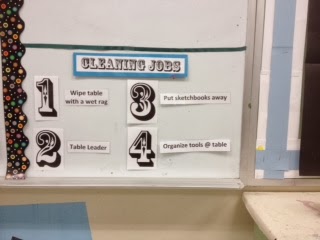
Seat Numbers: Each seat a the table is numbered. This number correlates to a number on the board which details their cleaning job for the week. I rotate these jobs every week. If a student is absent, then the table leader picks up the slack. I also use the seat numbers when collecting papers or randomly calling on students to answer questions.


Glaze Organization: I teach 3D art so we do a lot of ceramics. To keep that area organized I have the carts organized by the effect of the glaze. I create a sample medallion that is glued to the tops of the lids of the glazes. The only issue with this is that sometimes the medallion comes off, so I just re-glue it. I tried hot glue and that didn't work well enough. I am currently using Tacky Glue (I am open to suggestions of stronger glues to hold these sample medallions on).


Table Binders: Each table has a binder with copies of useful handouts. I also put then in plastic sleeves so that they do not get damaged. I put handouts in there from Elements and Principles, to SAT/ACT Vocabulary, and art techniques.


Practical Teaching Tip: Keep it simple and find a system that works for YOU! I have found it usefully to train and re-train the students throughout the year especially after breaks :)

Do you have any organizational systems to share? I would love to hear new organizational tips!

Thursday, December 19, 2013

Advanced Art Class Midterm: Student Art Blogs

In the past I have had my advanced art students create a website to showcase their artwork that they have created this year and previous years (as an online portfolio). This year I decided to do something different. I realized that when the students tried to log into their account second semester to update their website for the final exam, they forgot their passwords and in general didn't do much with the website- making it useless.

I am an avid Pinterest-er and have seen many posts from Apex High School. When I clicked on their actual blog I got inspired. The art teacher at that school has the students create an art blog- what a great idea! My students always ask if they can take pictures of their artwork to post on instagram and other social media outlets, so why not tie into my curriculum what they are actually interested in- social media.

For 3 days we went down to the media center and my students set up their blog. I still wanted to retain the aspect of the online portfolio so those requirements were still embedded in the rubric. By adding the aspect of the "blog" I wanted them to post 5 blog posts. I left it very open-ended; I told them that the idea behind this was to document the process of their art or they could use it as a personal reflection to the projects that they have created
.  
The requirements for their grade included:
  • A page for an artist statement (it could have been about a specific artwork that they created this year or just about their art in general)
  • The blog had to look professional, but still show their personality (you can see some students went a little too casual for my liking, we will be doing some updates when we get back from break).
  • There had to be a short biography
  • The Portfolio or Gallery had to have at least 5 images of their artwork with labels (name, title, size, medium and year)
  • ...and their blog posts
HERE is the link to the page on my blog where you can see my student's blogs!

I am excited to see how this develops throughout the school year. I plan on having the students post a least once a week and also doing online critiques through the comment section of the posts. 

Art Teacher: if you have ever tried anything like this before, share below- links, successes, failures and comments are always appreciated!

On another note, at this time tomorrow I will be officially on Winter Break!!!!!!- oh wait scratch that I have a game tomorrow night too-
 #artteacherbyday #cheercoachbyafternoon #wifeandsoontobemommaattheendofthenight